Top Signs You Need Garage Door Service – Don’t Ignore These
The five signs that most reliably mean your garage door needs service are slow or jerky operation, a loud bang from above the door, an uneven gap at the floor, a door that reverses mid-travel, and any blinking error light on your opener. Most homeowners notice these symptoms but guess wrong about the cause. A door that’s suddenly slow usually isn’t an opener problem. It’s often a spring that’s lost tension and is forcing the motor to work harder than its torque rating allows, which is how a small spring job turns into a spring-plus-stripped-gear job. If you’d rather not diagnose it yourself, call (855) 337-1360 and we’ll take a look.
Key Takeaways
- Most visible garage door symptoms trace back to the spring system, not the opener.
- In Spring, TX, late-summer heat stretches cables and winter cold fronts make springs brittle.
- You can safely check for spring gaps, cable slack and worn rollers without touching tension hardware.
- Blinking opener lights on LiftMaster and Chamberlain units carry precise failure codes worth reading.
- Waiting on a worn roller compounds into track damage and panel stress, which costs more.
What Does a Slow or Jerky Garage Door Actually Mean?
A slow or jerky garage door usually means the torsion or extension springs have lost tension, and the opener motor is straining to lift weight it wasn’t rated for. The jerking is the tell. A healthy door moves in one smooth arc from the floor to the header, and any stutter in that arc points to unbalanced load rather than a failing motor.
Here’s why that distinction matters. Your opener is designed to lift a door that’s already counterbalanced by its springs, so it’s doing maybe a third of the actual work. When a spring weakens, the motor picks up the slack. It runs hotter, its gear train takes stress it wasn’t built for, and the door gets louder and less predictable. In our experience, homeowners often replace the opener first and find the problem comes right back, because the spring was the real culprit all along.
If you notice a door that lurches, stalls partway up, or reverses before it reaches the header, hold off on repeated open-and-close cycles. Each attempt adds wear to the gear and rail. A quick call to arrange a spring check is cheaper than a motor replacement you didn’t need.
Springs carry dangerous tension even when they look calm. Never try to adjust, loosen or remove one yourself.
What’s That Loud Bang From the Garage?
A loud bang from above the garage door is almost always a torsion spring snapping, and it’s the most common serious garage door failure we deal with. The sound carries through the house because a wound spring releases years of stored tension in an instant. Homeowners describe it as a gunshot or a car backfiring.
After that bang, the door won’t lift normally. The opener might hum and click but nothing moves, or the door rises a few inches and stops. Leave it down. A door with a broken spring is holding hundreds of pounds of unbalanced weight, and forcing it up can damage the panels, the tracks and the opener gear in one motion.
Spring failure isn’t random, especially in Spring, TX. Our seasonal pattern runs two ways. Late summer heat expands the steel cables that run alongside the springs, letting them stretch and lose some of the tension holding the system in balance. Winter cold fronts do the opposite and make spring steel more brittle. That’s why a door that felt fine in October can sound different in January, and why a spring can fail on a day when nothing else changed.
Age and cycle count also play a role. Every open and close uses up part of a spring’s rated life, and a spring can’t be repaired once it shears. It has to be replaced as a matched pair if yours are a pair.
Why Is There a Gap at the Bottom of My Door?
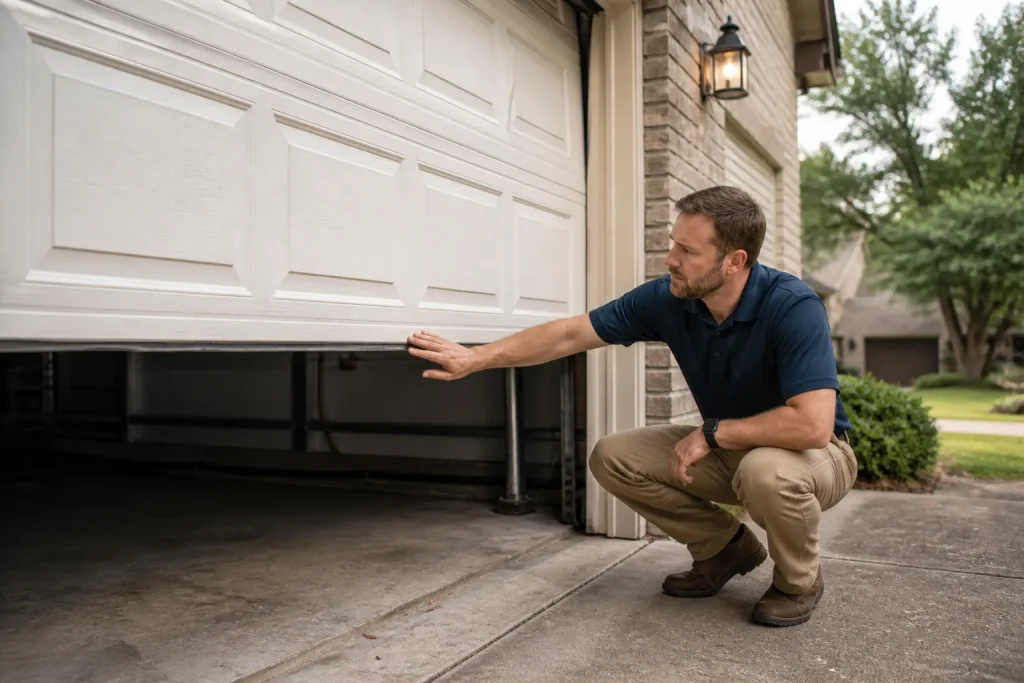
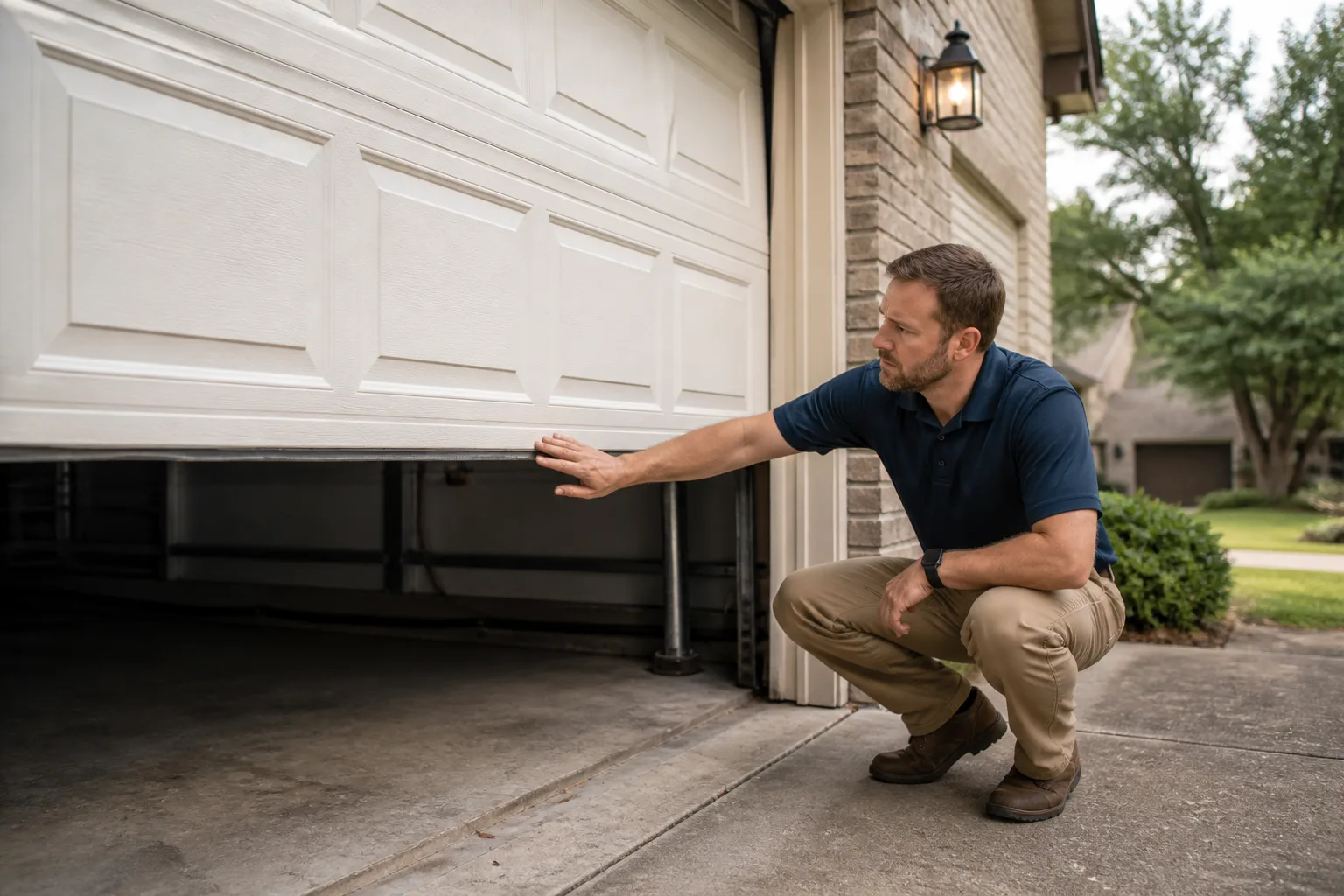
An uneven gap at the floor usually means one spring in a pair has weakened ahead of the other, tilting the door slightly on its tracks. It can also mean a bent track, a worn hinge, or a bottom seal that’s flattened out over time. The fix depends on which one it is.
To tell them apart, watch the door from the side as it closes. Focus on the gap.
- One corner sits higher: likely a spring imbalance on that side.
- The door drags or rubs on one track: likely a bent or misaligned track.
- The gap is even all the way across: likely just a worn bottom seal.
A gap is easy to ignore because the door still moves. But it lets in water, pests and outside air, and it puts uneven stress on the panels and hinges on the high side. Over a few months, that stress can crack a hinge or warp a panel, which is a bigger repair than a spring adjustment. If you can’t tell which problem you’ve got, a technician can check the balance and track alignment in a short visit.
What Can You Safely Check Yourself?
You can safely check for a spring gap, cable slack and roller wear without touching any of the tension hardware. A quick visual inspection once or twice a year catches most problems before they get expensive.
- Look at the springs. Torsion springs sit on the bar above the door; extension springs run along the tracks. With the door closed, a healthy torsion spring has a tight, even coil. If you see a visible gap between the coils, that spring has lost tension.
- Check the cables. Look at the cables running down each side to the bottom brackets. They should be taut, with no fraying or loose strands. A sagging cable means the door is out of balance.
- Inspect the rollers. Rollers are the wheels in the tracks. Worn rollers look flattened, cracked or loose on their stems.
- Test the safety reverse. Place a roll of paper towels on the floor under the door and close it. The door should reverse when it touches the roll.
Notice what that list leaves out. Do not stick your hands near the spring bar, the cables or the bottom brackets. Those parts carry dangerous tension, and a mistake there can cause real injury. Test, don’t touch.
What Do Your Opener’s Error Lights Tell You?
Opener error lights give you precise failure data that most homeowners ignore. On a LiftMaster or Chamberlain unit, the LED on the back or side of the motor blinks a set number of times, pauses, then repeats. The count points to a specific fault.
Count the blinks and note the pattern before you call. A few examples of what different patterns typically point to:
- A short blink sequence repeating frequently often means a safety sensor is blocked, misaligned or dirty.
- An even, rhythmic pattern can indicate a travel limit or force adjustment problem.
- A light that flashes rapidly and the door won’t move at all sometimes points to the opener having lost its remote signal or a control-board issue.
A Genie unit works similarly but uses its own set of codes. The real value of reading the light is that it tells you whether the opener is reporting a sensor problem, a gear problem or a motor problem before anyone climbs a ladder. That saves a diagnostic step and, on a Chamberlain or LiftMaster system, rules out plenty of false leads.
Your door brand matters here too. A Clopay or Amarr door paired with a newer opener can feel out of balance even when both parts are healthy if they weren’t set up together. We know the brands well enough to tell system problems from component problems.
Why Waiting Makes the Repair Costlier?
A worn roller left alone creates track damage, and track damage creates panel stress. That’s the compounding failure risk most homeowners miss. A five-dollar roller is cheap. A damaged track and a cracked panel aren’t.
Here’s how the chain works. A flat or frozen roller drags its side of the door, the drag forces that end of the door to shift, and the shift puts side force on the track. Over time the track bends. Once the track bends, the door binds. Once the door binds, the panels carry uneven weight and hairline cracks can start at the hinges and edges.
We’ve seen doors that started with a single squeaky roller and ended up needing new panels or a whole new door, because every month the minor problem got a little worse. The same pattern plays out with a spring running low on tension: the opener works harder, the gear wears, and the shaft takes extra load. That’s how a $180 spring job can become a $320 spring-plus-stripped-gear job if the symptoms are allowed to pile up.
A short issue like a nick in a Wayne Dalton panel or a worn Raynor roller is worth fixing quickly. Ignoring it turns a small part into a larger one.
When to Call a Pro
Call a pro when you see a spring gap, hear the bang, get an unbalanced door, or spot a blinking error code you can’t identify. Spring and cable work is too dangerous for a homeowner to take on, and the diagnostics are faster when someone knows the difference between an opener fault and a door-balance problem. We can also walk you through what a typical job involves so you’re not surprised by the scope.
Related services in Spring: garage door repair if something’s broken now, and garage door opener repair if the motor, sensors or error codes are the issue. For an aging system, we also handle garage door installation.
We carry the parts. We know the brands. We fix it right the first time. For more on who we are and how we work, see Spring Garage Door Repair Pros.
The Bottom Line
Slow operation, a loud bang, an uneven gap, jerky movement or a door that reverses mid-travel all point to a specific component failing, usually in the spring system. In Spring, TX, the seasonal heat and cold fronts make that pattern predictable rather than random. Check the easy things safely, count your opener error blinks, and don’t ignore a cheap part that’s already failing.
If you’re in Spring and need help, Spring Garage Door Repair Pros offers free estimates. Call (855) 337-1360. Our technicians have up to 10 years of experience and know the mechanical heart of your door inside and out.
Frequently Asked Questions
Slow or jerky operation is the most common sign, and it usually points to a spring that’s lost tension rather than an opener problem. The motor is straining to lift weight the springs should be handling. Call (855) 337-1360 for a free estimate.
No. A broken or tensioned spring carries enough stored energy to cause serious injury, and springs must be replaced with proper calibration tools. Leave this to a trained technician. Call (855) 337-1360 and we’ll handle it safely.
A door that reverses mid-travel usually means the safety sensors are misaligned, dirty or blocked, or that a force setting is off. On a LiftMaster or Chamberlain unit, count the blink code on the motor and it’ll point you in the right direction. Call (855) 337-1360 for a diagnosis.
Replace both if yours are a matched pair. Springs wear at similar rates, so a new single springs against an old one throws the door out of balance all over again. Call (855) 337-1360 for a free estimate on the pair.
Written by the team at Spring Garage Door Repair Pros.
Need Garage Door Help?
Call Spring Garage Door Repair Pros - the local pro we connect you with is licensed and insured, here with fast after-hours help in Spring.
(855) 337-1360